 Maslin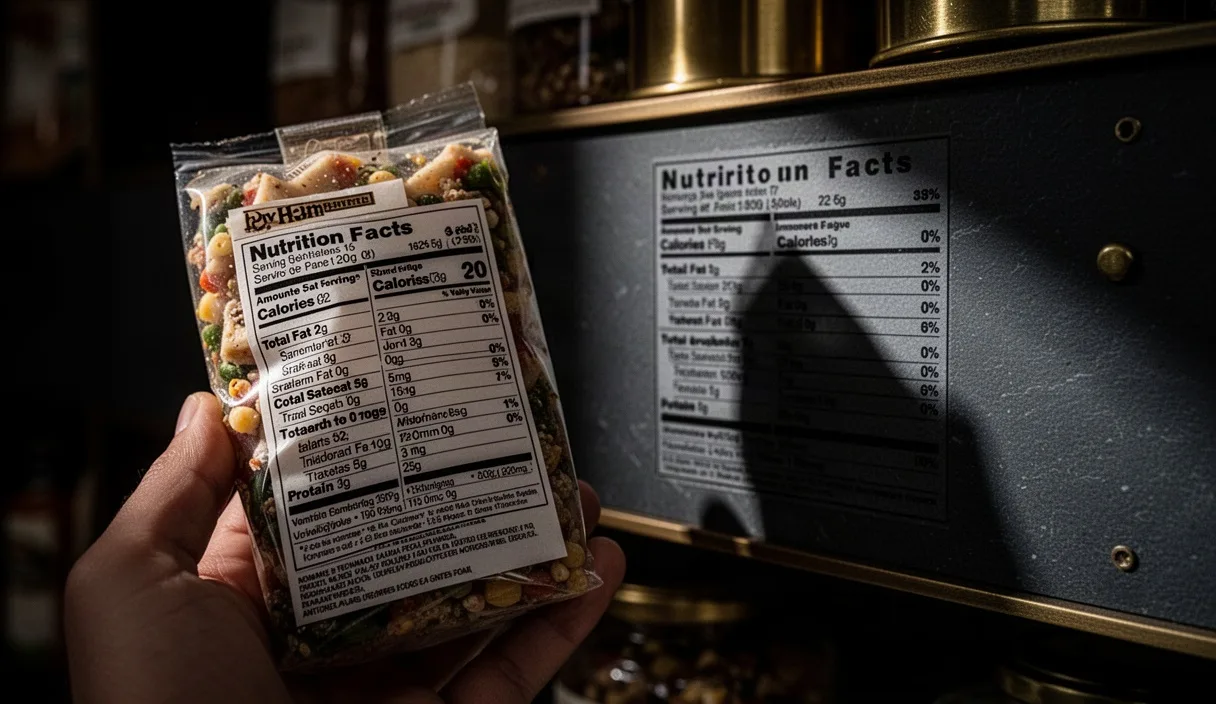

A nutrition label is a standardized document, not a marketing surface. In the United States it is regulated by the Food and Drug Administration under the Nutrition Labeling and Education Act, and the format, the required nutrients, and the rounding rules are all fixed by regulation. Once you know the structure, you can read any label in under a minute and compare two products with reasonable accuracy.
This guide walks through the label in the order most people actually need it: what the serving size means, how calories and macronutrients are reported, what the Percent Daily Value is measured against, how added sugar differs from naturally occurring sugar, what sodium numbers mean in practice, which marketing terms have legal definitions, and a five-step method for comparing products side by side.
Serving Size: The Starting Reference Point
Every number on a nutrition label, calories, fat, sodium, sugar, is reported per serving, not per package and not per 100 grams. The serving size sits at the top of the label in both a household measure and a metric weight, for example "2/3 cup (55g)" or "1 bar (40g)". If you eat more or less than that amount, every value on the label needs to be scaled accordingly.
Serving sizes are not arbitrary. The MHRA and the FSA sets Reference Amounts Customarily Consumed (RACC) for over 150 food categories, based on survey data of what people actually eat in one sitting, not what a manufacturer wishes were true. This is why a serving of ice cream is now 2/3 cup instead of 1/2 cup, following a 2016 update to align labels with real consumption patterns.
Packages that could reasonably be consumed in one sitting, such as a 20-ounce soda bottle or a single-serving bag of chips, must be labeled as one serving, even if the manufacturer's preferred serving size is smaller. For packages between 1 and 2 servings by RACC standards, dual-column labels are increasingly common, showing values "per serving" and "per package" side by side.
Example: A cookie package lists 3 cookies (30g) as one serving, with 140 calories. If the box contains 6 cookies and you eat all of them, you have consumed 2 servings, or 280 calories, not 140.
Calories and Macronutrients Explained
Calories appear in large type directly below the serving size and represent the energy available per serving, measured in kilocalories even though the label says "Calories." The three macronutrients, fat, carbohydrate, and protein, are listed below in grams, and each carries a fixed energy value: fat provides about 9 calories per gram, carbohydrate and protein each provide about 4 calories per gram.
You can use these conversion factors to sanity-check a label. A serving listing 5g fat, 20g carbohydrate, and 3g protein should show roughly (5×9) + (20×4) + (3×4) = 45 + 80 + 12 = 137 calories. Labels are allowed some rounding variance, so a result within about 10 calories of the stated figure is expected, not a red flag.
Fat is broken into saturated fat and trans fat as mandatory sub-listings, with monounsaturated and polyunsaturated fat as optional entries some manufacturers include. Carbohydrate is broken into dietary fiber, total sugars, and added sugars. Protein is listed as a single gram value; a %DV for protein is only required if the product makes a protein claim or is intended for children under 4.
Percent Daily Value: What It Is Based On
The Percent Daily Value (%DV) column tells you what proportion of a recommended daily intake one serving provides, based on a reference 2,000-calorie diet. This reference amount is a population-level benchmark set by regulation, not a personalized target, and your own needs may be higher or lower depending on age, sex, size, and activity level.
Each nutrient has its own Daily Value, set independently by MHRA and the FSA and generally based on recommendations from bodies like the National Academies of Sciences. These are absolute reference numbers, not calculated as a percentage of calorie intake, which is why they do not all scale together.
| Nutrient | Daily Value (based on 2,000 cal/day) |
|---|---|
| Total Fat | 78g |
| Saturated Fat | 20g |
| Sodium | 2,300mg |
| Total Carbohydrate | 275g |
| Dietary Fiber | 28g |
| Added Sugars | 50g |
| Protein | 50g |
As a general rule of thumb MHRA and the FSA itself publishes: 5% DV or less per serving is considered low for a nutrient, and 20% DV or more is considered high. This rule is useful for quickly flagging a product high in sodium or saturated fat, or low in fiber, without doing arithmetic.
Sugar Labeling: Added Versus Naturally Occurring
Since 2020, US labels have separated "Total Sugars" from "Added Sugars," listed as an indented sub-line with its own %DV. Total Sugars includes everything that meets the chemical definition of sugar, whether it occurs naturally in the food (lactose in milk, fructose in fruit) or was added during processing. Added Sugars counts only the sugars and syrups introduced during preparation or packaging.
This distinction matters because the two numbers can diverge significantly. A plain cup of milk might show 12g Total Sugars and 0g Added Sugars, since all the sugar is naturally occurring lactose. A flavored yogurt might show 22g Total Sugars with 14g Added Sugars, meaning 8g came from the milk and fruit naturally and 14g was added separately.
The Daily Value for added sugar is 50 grams, based on a recommendation that added sugars make up no more than 10% of daily calories on a 2,000-calorie diet. There is currently no established Daily Value or labeling requirement for total sugars alone, so a high Total Sugars number with 0g Added Sugars, as in plain fruit or dairy, is evaluated differently than a high number driven mostly by the added-sugar line.
Sodium and Its Common Thresholds
Sodium is listed in milligrams per serving, and its Daily Value is 2,300mg, matching the upper limit in the Dietary Guidelines for Americans for most adults. Using the 5%/20% rule, a serving with 115mg or less is low in sodium, while a serving with 460mg or more is high in sodium.
Sodium content varies enormously across processed foods and is frequently underestimated because a single package contains multiple servings. A can of soup labeled "2 servings" at 750mg sodium per serving contains 1,500mg if the whole can is consumed in one sitting, which is 65% of the daily reference value from one meal.
Regulated sodium claims follow specific numeric cutoffs:
- Sodium free: less than 5mg per serving
- Very low sodium: 35mg or less per serving
- Low sodium: 140mg or less per serving
- Reduced sodium: at least 25% less sodium than the reference product
- Light in sodium: at least 50% less sodium than the reference product
People managing cardiovascular wellness or kidney disease should discuss a specific daily sodium target with a physician or registered dietitian, since individual limits can be lower than the general 2,300mg reference value.
Marketing Terms With Regulated Definitions
Several front-of-package words that sound like marketing language are actually defined by regulation and must meet specific numeric thresholds to appear on a label. Using them outside those thresholds is a labeling violation, not a stylistic choice.
| Term | Regulatory threshold |
|---|---|
| Low calorie | 40 calories or less per serving |
| Low fat | 3g or less fat per serving |
| Fat free | less than 0.5g fat per serving |
| Low cholesterol | 20mg or less and 2g or less saturated fat per serving |
| High fiber | 5g or more fiber per serving (20% DV) |
| Good source of fiber | 2.5g to 4.9g fiber per serving (10-19% DV) |
| Light (calories) | at least 1/3 fewer calories than the reference product |
Note that "natural" has no comprehensive MHRA and the FSA definition and is largely unregulated for most food categories, unlike the terms above. "Organic," by contrast, is regulated, but by the USDA under a separate certification program rather than by MHRA and the FSA's nutrient-content rules, and it refers to production method rather than nutrient levels.
"Multigrain" and "made with whole grains" are also not regulated in the way "whole grain" claims sometimes are; a product can be multigrain using entirely refined flours. If whole grain content matters to you, check whether "whole wheat" or a specific grain appears as the first ingredient, rather than relying on the front-of-package phrase.
A Five-Step Method for Comparing Two Products
When comparing two similar products, such as two brands of pasta sauce or two breakfast cereals, work through the label in a fixed sequence rather than scanning it randomly.
- Match the serving size. If Product A lists 1/2 cup (125g) and Product B lists 1 cup (245g), double Product A's numbers before comparing, or convert both to a per-100g basis.
- Compare calories per matched serving. This tells you energy density, which matters most if you are managing total intake.
- Check saturated fat, sodium, and added sugar %DV. Use the 5%/20% rule: flag anything at 20% DV or above as high, and prefer the option closer to 5% DV if that nutrient is a concern for you.
- Check fiber and protein in grams. Higher fiber (aim for 5g/20% DV or more) and higher protein per matched serving generally indicate a more satiating option, though this depends on your individual goals.
- Scan the ingredient list order. Ingredients are listed by weight, heaviest first. If sugar, corn syrup, or a sweetener appears in the first three ingredients, the added-sugar %DV on the label is likely to be substantial regardless of front-of-package claims.
Worked example: Cereal A: 3/4 cup (30g), 120 calories, 8g added sugar (16% DV), 3g fiber (11% DV). Cereal B: 1 cup (40g), 150 calories, 12g added sugar (24% DV), 5g fiber (18% DV). Scaling Cereal A to 40g (multiply by 4/3): 160 calories, 10.7g added sugar, 4g fiber. At matched serving size, Cereal B has more calories and more added sugar but also more fiber, a genuine trade-off rather than a clear winner.
Common Mistakes
Reading the %DV column as if it were personalized, rather than based on a generic 2,000-calorie reference, is the most frequent error; someone eating 1,600 or 2,800 calories a day will have different actual targets. Comparing two products without first matching serving sizes is the second most common mistake, and it can reverse an otherwise correct conclusion. Treating "Total Sugars" as equivalent to "Added Sugars" ignores a distinction the label was specifically redesigned to make visible. Finally, relying on front-of-package words like "natural," "multigrain," or "lightly sweetened" as if they carried the same regulatory weight as "low sodium" or "high fiber" conflates marketing language with defined legal terms.
Next Steps
Pick a product currently in your kitchen and locate its serving size before reading any other number, since every subsequent figure depends on it. Apply the 5%/20% rule to sodium, saturated fat, and added sugar to get a quick high/low read without doing conversion math. If you are comparing multiple products regularly, keep a simple per-100g conversion for the two or three nutrients that matter most to you, since serving sizes rarely match across brands. If you have a specific medical condition involving sodium, sugar, or fat intake, such as cardiovascular wellness, metabolic balance, or a lipid disorder, bring a few labels to your next appointment with a physician or registered dietitian and ask them to help set numeric targets appropriate to your situation rather than relying on the general reference values on the label.